
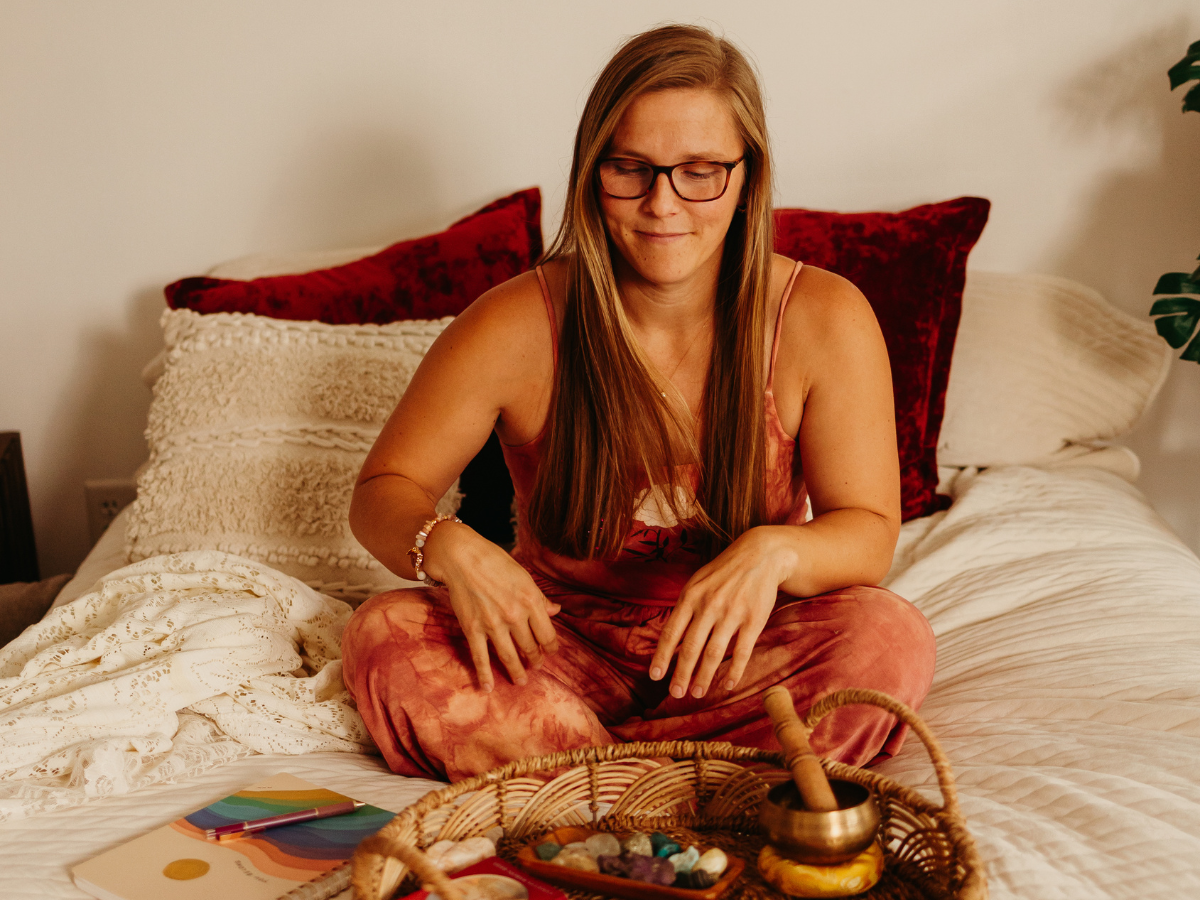
I get asked this a lot: okay, but what do you actually do with them?
Because there's a difference between having oils and using them intentionally. Between reaching for lavender because it smells nice and reaching for Trauma Life because you know something in your body needs to move and you can't quite get there on your own.
This post is for the second kind of person. The one who's already doing the inner work — or wants to — and is ready to understand how oils can meet you there.
Here's how I do it.
The biggest mistake I see is treating oils like an on/off switch.
So before I open a single bottle, I slow down. Feet on the floor. A few deep breaths. I ask myself: what am I actually feeling right now, underneath the surface? Not what I think I should feel. What's actually there.
This sounds simple. It's not always easy. But it's the difference between aromatherapy and actual emotional work.
Once I'm present, I don't intellectualize the selection. I'll pull out the oils I'm drawn to and I smell them in turn — slowly, with my eyes closed — and notice what happens in my body.
Does something soften? Does something tighten? Does a feeling rise up that I wasn't expecting?
That's information. The body knows before the mind catches up, every time.
A few oils that come up again and again in my own practice:
Trauma Life — this one goes deep. I reach for it when something old is surfacing, something that doesn't have words yet. It was formulated specifically to support the release of buried emotional trauma. I apply it to the back of my neck and over my heart and just... let it work.
Release — exactly what it sounds like. When I feel stuck in a loop — ruminating, gripping, unable to let something go — this is the one. For the "swirls."I apply it over my liver (an emotional release point in many traditions) and take long, slow exhales.
Inner Child — this one surprises people. It's gentle but it goes somewhere specific. I use it when the thing I'm processing has roots in something younger, something that happened before I had language for it. I also love it for when I'm tapping into free flow creative space.
Surrender — for when I find myself fighting myself. When I know what needs to happen but I'm resisting. A drop in the palms, cupped over the nose, and a conscious intention to stop pushing.
Stress Away— The name says it all. A classic go-to that's sweet and gentle in smell yet radically shifts a "mood." Got a case of the crankies? Let this one in for a shift from cranky to calm.
Where you apply matters. I'm not talking about reflexology in a clinical sense — I'm talking about bringing conscious awareness to the body part you're working with.
Over the heart for grief or love. The back of the neck for releasing what you've been carrying. The wrists for something you want to breathe in consciously. The feet for grounding when you're unmoored. The solar plexus for anything around power, worthiness, or control.
Apply slowly. Stay with the sensation. Don't rush to the next thing.
The thing that matters most here is you following your innate known sense of where to place the oil. You might be feeling grief yet if you're really listening you might find yourself putting the oil across your thighs- the key is to just allow and follow. No questioning necessary.
This is the step most people skip, and it's the most important.
When you use oils intentionally for emotional work, things can move. Memories surface. Tears come. Old anger shows up. That's not a bad reaction — that's the point. But you need somewhere to put it.
Before I sit down with oils for deeper work, I have something ready: my journal, a voice memo app, or simply time and privacy. I'm not doing this between meetings or while the kids are home. I'm treating it like a session- like a mini therapy for myself, a moment of ceremony for myself.
Give yourself at least 20-30 minutes. Let what comes up come up. Write it, speak it, breathe through it. The oil opened the door — your job is to walk through.
When something shifts, the nervous system needs help landing back in the body. I don't just close my journal and go make lunch.
I reach for grounding oils: Grounding blend, Cedarwood, or Sacred Frankincense. Applied to the soles of my feet or the base of my spine. I take a few slow breaths, drink water, usually step outside (being in nature always aids any process).
This signals to the body: we're safe, we're here, that work is complete for now.
This isn't a perfect protocol. It doesn't look the same every time. Some days one oil is all it takes. Some days I'm in it for an hour. The point isn't to follow steps — the point is to bring intention to something your body has been waiting for permission to release.
The oils don't heal you. You heal you. They just make it a little easier to begin.
If you're not sure where to start, Young Living's Feelings Kit was practically made for this kind of work — it's a curated collection of six oils specifically intended for emotional processing. It's where I'd send anyone who wants to begin intentionally.
❤️ Melissa
P.S. Some links in this post may contain affiliate links, which means I earn a small commission if you purchase through them — at no extra cost to you. I only recommend what I use and trust myself.

For mindful living + conscious conversation +
metaphysical magic from my heart to yours
P.S. This is the only place I share this type of content <3